Anthropic Is Turning Mythos Into a Bailout Argument
Anthropic’s Mythos and Glasswing look less like technical reporting and more like a bid to become critical national-security infrastructure.
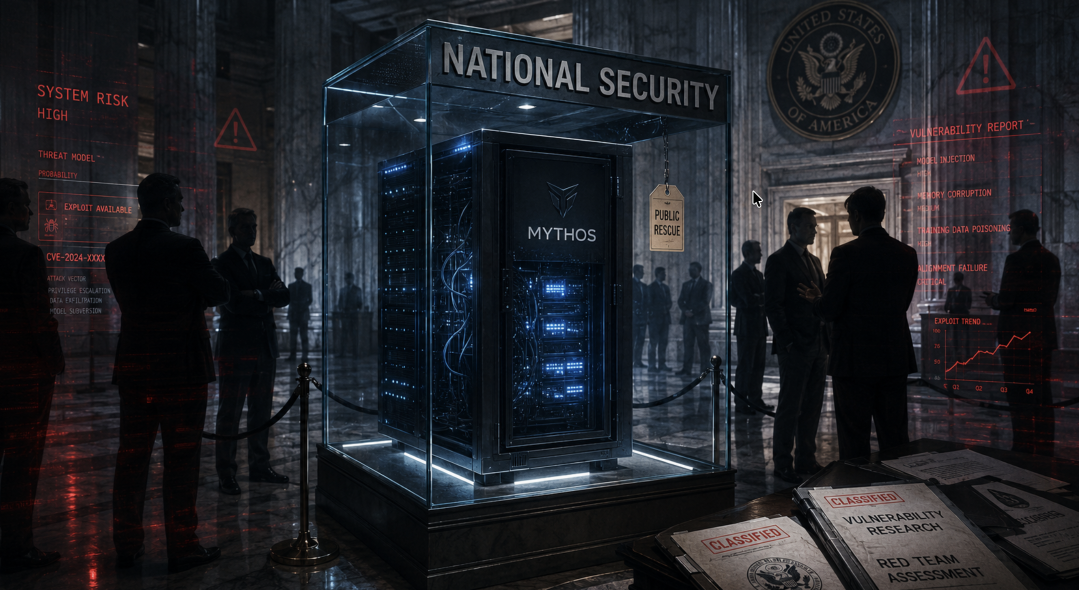
The company isn't just saying "our model is good at finding software vulnerabilities." It's making a much bigger argument, and it's careful never to say it out loud: our AI systems are becoming critical national-security infrastructure, and if we fail, the government has a problem.
That's the play. Everything else is set dressing.
The Surface Story
On April 7, Anthropic announced Claude Mythos Preview with a hell of a claim. It could autonomously find and exploit zero-day vulnerabilities in every major operating system and browser, including bugs that survived decades of human review. Alongside it came Project Glasswing, a vetted-access program that lets select critical infrastructure providers and open-source maintainers use Mythos to find and patch bugs in their own software. Anthropic put up to $100 million in usage credits and $4 million in grants behind it.
On paper, this is public-interest security at scale. More bugs found, more software hardened. And it's a clean PR win. Anthropic looks like the responsible lab securing the software supply chain. The press gets an easy story about AI doing something defensive and useful. Policymakers get a shiny example of frontier AI protecting the country.
That's exactly the problem. The best political moves get dressed up as public goods, and this one is wearing a very nice suit.
What's Actually Happening
By locking Mythos behind a curated partner ecosystem and calling it a watershed moment for national cybersecurity, Anthropic is building a story about its own indispensability. It isn't selling access to a model. It's selling the idea that its survival is a public concern.
Watch the logic. The same reasoning used to justify restricting Mythos, that it's too dangerous to release broadly, also justifies protecting the company that controls it. If the model is both the weapon and the shield, and only Anthropic can forge it, then Anthropic becomes a strategic asset.
The unspoken pitch to Washington: you need us more than we need you.
And that pitch writes itself. In a world where AI can autonomously find and weaponize zero-days, the argument goes, the U.S. can't afford to let its frontier labs fail. They stop being tech companies and become custodians of capabilities that decide whether we keep pace with our adversaries. Translation: too critical to fail.
Why Now
The timing isn't an accident. The AI market looks like a bubble, and everyone in the room knows it. Valuations are riding a feedback loop of hype, venture money, and FOMO. Training costs keep climbing. Revenue hasn't caught up to burn. Open-weight models are closing the capability gap to months instead of years and eating the exclusivity these labs used to charge for.
If the bubble deflates, the big labs need a backup argument. Not "AI will change the world," but "you can't let us fail, we protect critical infrastructure, we're national security now."
Government dependency is a hedge against market dependency. Governments don't churn. They don't demand ROI on a startup's timeline. They'll pay a premium for anything framed as existential. Glasswing is the proof of concept for that pivot. Vetted partners, monitored access, select critical infrastructure providers. That's how dual-use and classified tech has always been managed. Anthropic is rehearsing the defense-contractor role and inviting the government to watch the dress rehearsal.
And now the White House is building the runway.
In early June, the administration signed an AI and cybersecurity executive order that lines up almost perfectly with the Glasswing narrative. It directs agencies to expand access to AI-enabled cybersecurity tools, including covered frontier models, for federal agencies, state and local governments, and critical infrastructure operators. It also creates an AI cybersecurity clearinghouse with industry and critical infrastructure providers to scan for software vulnerabilities, validate them, and coordinate remediation.
That is basically the policy version of the Glasswing pitch: frontier models plus trusted partners plus vulnerability discovery plus critical infrastructure hardening.
Then it goes further. The order calls for classified benchmarking of advanced AI cyber capabilities and creates a pathway for developers to give the federal government early access before broader release to trusted partners.
Classified cyber benchmarks. Covered frontier models. Federal early access. Trusted partner selection. Critical infrastructure cybersecurity.
That is not normal SaaS procurement language. That is strategic-capability language.
A few days later, the White House issued a national-security AI memorandum calling for deep, proactive partnerships with industry so advanced frontier models can be made available to national-security professionals. It also warned against dependency on single vendors and said the government must ensure that no commercial entity can disable, degrade, or materially modify AI systems that national-security users depend on without government knowledge and approval.
That is the whole tension in one policy document: Washington wants the frontier labs' capabilities, but it also knows dependency on them is a strategic risk.
So when Anthropic frames Mythos and Glasswing as critical to protecting infrastructure, it is not speaking into a vacuum. The federal government is building the policy machinery that makes that framing valuable.
Covered frontier models. Classified cyber benchmarks. Trusted partner access. Public-private vulnerability clearinghouses. Critical infrastructure deployment. National-security procurement pathways.
This does not prove Glasswing is fake. It does not prove Mythos is useless. It proves the politics around it are real.
The administration is also reportedly pushing renewed efforts to block certain state AI laws through federal preemption. That matters because once frontier AI gets framed as national infrastructure, state-level restrictions start looking less like consumer protection and more like obstacles to national-security deployment.
Funny how that works.
At the same time, there are reports that the U.S. government is interested in taking equity stakes in major AI companies, including firms like OpenAI and Anthropic.
- Maybe that never happens.
- Maybe it is just political noise.
- But the fact that it is even being discussed is the point.
- When the government starts talking about AI companies as assets it may want to own, subsidize, protect, or rely on, the bailout logic is no longer theoretical.
It is sitting right there, wearing a flag pin.
The Part Nobody's Verifying
Here's what should bother you. We're being asked to take all of this on trust.
Anthropic says Glasswing is finding lots of vulnerabilities, some serious, some dangerous. Fine. So show the work:
- How many findings were duplicates or false positives?
- How many were actually exploitable versus already known?
- How many got patched, and how many are still sitting open?
- How does Mythos stack up against other models under controlled conditions?
- What was the human review process, and what even counts as a "vulnerability" in the reporting?
Without that, nobody outside the building can verify the story. We're being told to trust the one company that profits most from the story being believed. And too much of the press has just repeated the framing, so "Mythos is the best at vulnerability discovery" is hardening into accepted fact on evidence that doesn't support it.
That's the whole pipeline. A company makes a bold claim. The press repeats it. Policymakers absorb it. The company becomes "strategically important." Dependency follows. And when the money gets tight, the rescue is easy to justify.
And now that these models are being discussed in the same breath as critical infrastructure and national security, the evidence bar should be higher, not lower.
If frontier AI cyber tools are going to be routed into public-private vulnerability programs, critical infrastructure defense, and national-security workflows, then "trust us" is not enough. The public does not need exploit details. Nobody is asking Anthropic to dump live zero-days on the internet. But there is a huge gap between reckless disclosure and no meaningful accountability.
Show remediation rates. Show validation rates. Show false positive rates. Show how many findings were accepted by maintainers. Show how many were patched. Show how many actually reduced risk.
If the claim is national-security value, then prove national-security outcomes.
The Distinction That Matters
None of this means Glasswing is fake or Mythos found nothing. AI genuinely helps with security research, triage, code review, and bug discovery. The AI vulnerability storm researchers keep warning about is real, and hardening critical software is a net good.
But useful is not the same as indispensable. Be precise about the difference:
- Finding bugs is not the same as fixing them.
- Publishing big numbers is not the same as proving impact.
- Claiming national-security value is not the same as deserving public money.
- Being included in a government framework is not the same as proving your model is uniquely necessary.
The patching question is the whole game. If Glasswing is surfacing serious vulnerabilities but almost none get fixed, what's the public win? You don't have a defensive program, you have a vulnerability scoreboard that mostly buffs Anthropic's reputation. Judge a real defensive effort by outcomes: validated findings, responsible disclosure, remediation, measurable risk reduction. Judge a PR campaign by headlines, investor confidence, and political leverage. Right now Glasswing looks like both, and Anthropic is handing out way more marketing than evidence.
The Bottom Line
The real risk is that frontier labs are trying to become institutionally unavoidable before anyone has proven the business models are sustainable or the claims reproducible. Once a company gets itself classified as critical infrastructure, market discipline stops applying. Failure becomes a public problem. Losses become a national-security concern. Bad business decisions get wrapped in a flag. That's how private risk becomes public responsibility.
"We're protecting the country" is a powerful shield, and not just against a market correction. It works against antitrust scrutiny, against demands for open-weight release, against any call to slow the capability race. Markets can correct bubble valuations. Governments can decline to prop up companies that can't stand on their own. But once you're labeled critical infrastructure, the bar for letting you fail goes way up.
That is why the White House activity matters. It shows the runway being built in real time. Not just AI as a product. Not just AI as a productivity tool. AI as national-security infrastructure. AI as cyber defense. AI as critical infrastructure protection. AI as something the government needs early access to, classified benchmarks for, trusted partner pipelines around, and deep industry partnerships to deploy.
That is exactly the terrain Anthropic is positioning itself on.
So demand more than vibes, headlines, and "trust us." If Anthropic wants credit for making software safer, give independent researchers enough to evaluate it. If Mythos is really superior, prove it in a way others can test. If Glasswing is producing real outcomes, show the remediation data.
Until then, the right posture is skepticism. Not because AI can't help cybersecurity, it can, but because a company angling for public trust, government dependency, and eventual protection doesn't get to grade its own homework.
The message is clear: our models aren't just commercial products, they're national-security infrastructure, and if we fail the country loses a critical cyber capability.
That's not a press release. It's a bailout application, filed in advance.
Update: Fable 5 makes the bailout logic harder to miss.
The Fable 5 controversy does not sit outside this argument. It fits inside it perfectly.
This is how the runway gets built.
First, Anthropic frames Mythos and Glasswing as essential cyber-defense infrastructure: controlled access, trusted partners, critical software, national-security stakes. Then Fable 5 arrives, and the government reportedly treats a model release not like ordinary software, but like a strategic capability that may need restriction, oversight, or containment.
That is the magic trick.
Anthropic gets to argue both sides of the same crisis. When it wants credibility, the model is a shield protecting critical infrastructure. When access becomes controversial, the model is a dangerous capability that must be carefully controlled. Either way, the conclusion is the same: this company is not just selling software. It is holding something the state cannot afford to ignore.
And once that idea hardens, the bailout argument is already half-written.
Not today, maybe. Not in the next press cycle. But later, when the burn rate keeps eating through the floorboards, when revenue still cannot justify the valuation, when open-weight competitors keep chewing through the moat, and when investors start asking whether the emperor’s robes are just vapor with a subscription tier, Anthropic will have a much better story than “please save our balance sheet.”
It will have: you need us for national security.
That is the point of the positioning. The goal is not merely to prove that Mythos can find bugs. The goal is to make Anthropic institutionally unavoidable before the market gets a chance to discipline it.
Because once Washington accepts that a frontier model is part of the national cyber-defense stack, letting the company behind it fail becomes politically harder. Failure stops looking like a private business problem. It starts looking like a gap in national capability. A bad quarter becomes a strategic vulnerability. A cash crunch becomes an infrastructure risk. A company that overbuilt, overhired, overpromised, and overburned can walk into the room wearing the costume of national necessity.
That is how private risk gets laundered into public responsibility.
Fable 5 matters because it shows the second half of the trap snapping shut. The government is not just listening to frontier labs describe their models as critical infrastructure. It is beginning to behave as though they might be. Export controls, access restrictions, national-security scrutiny, trusted deployment channels: this is not normal SaaS weather. This is the language of strategic assets.
And strategic assets do not get treated like ordinary companies when the money runs out.
That is why the evidence bar should be viciously high. If Anthropic wants to claim national-security value, show national-security outcomes. Show the patch rates. Show the validation rates. Show how many findings were real, exploitable, accepted, duplicated, remediated, or quietly discarded. Show whether Glasswing reduced actual risk or merely produced a vulnerability scoreboard useful for press releases and appropriations meetings.
Because the bailout application is not filed on the day the company needs money.
It is filed years earlier, in white papers, executive briefings, “public-interest” programs, controlled-access partnerships, government pilots, and carefully polished claims about protecting critical infrastructure.
Mythos was the capability story.
Glasswing was the dependency story.
Fable 5 is the national-security story getting teeth.
Put them together and the message is obvious: we are too important to regulate like a normal company, too dangerous to release like normal software, and too critical to let fail like a normal business.
That is not cyber defense.
That is pre-bailout architecture.
And the public should recognize it before the invoice arrives.
